On Mardy's Front Porch: Miriam Horn Brings the Story of George Schaller Home to the Murie Ranch
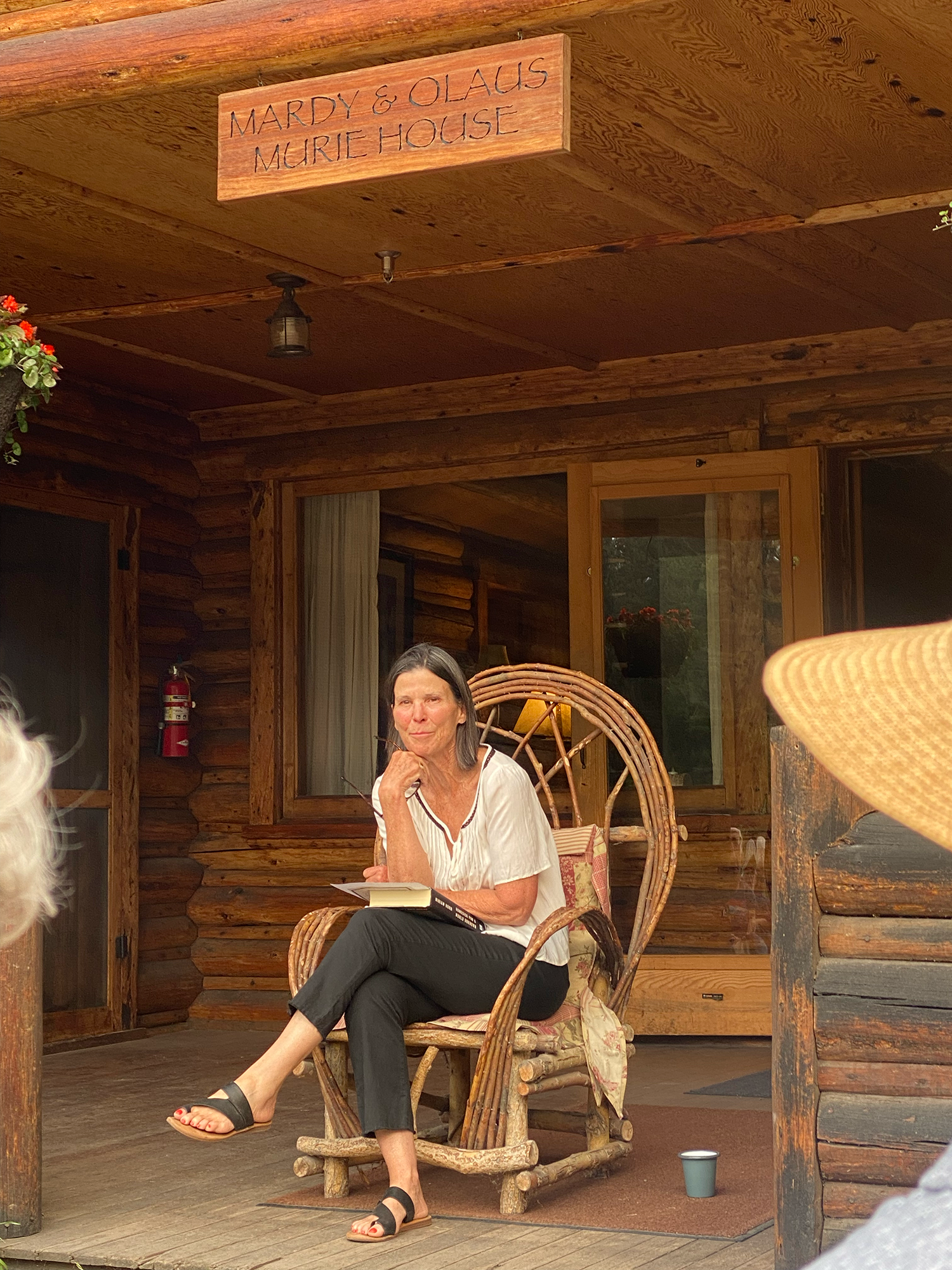
Miriam Horn at the Murie Ranch
On August 11, 2026, people (and one very well-behaved puppy named Bella) gathered on the historic front porch of the Murie Ranch in Grand Teton National Park. They came to hear author Miriam Horn talk about legendary field biologist George Schaller. The evening was part of Teton Science Schools' Murie Ranch Front Porch Series, presented in partnership with the Grand Teton National Park Foundation. It was a fitting place to tell his story, because as Horn made clear, Schaller's remarkable career began in the company of Olaus and Mardy Murie.
A Porch with a Legacy
Olaus and Mardy Murie hosted many of the nation's most influential conservationists on their front porch in Moose, Wyoming. Many of the ideas that shaped the modern American conservation movement took root in those conversations. Howard Zahniser of The Wilderness Society drafted the Wilderness Act on that porch, and the Muries' advocacy helped lead to the protection of the Arctic National Wildlife Refuge.
Teton Science Schools keeps that tradition alive through the Front Porch Concerts and Conversations series. Each summer, guests gather on Mardy's porch for free evening programs featuring speakers and musicians connected to nature, conservation, and the Murie legacy. The 2026 season included:
Grand Teton Music Festival performances
Research on Grand Teton's wild canids
A conversation on citizen wildlife advocacy with a Wyoming legislator
A panel on the health of the Snake River Headwaters
The program is free to attend. Rain gear and lawn chairs are encouraged, and so is curiosity. Front Porch Out & About extends the series into the rest of the year with talks at Teton Science Schools' campuses.
Murie Ranch Program Manager John Gallagher opened the evening by describing a kind of "Murie Magic": the way this small homestead continues to bring people together around wild places. He even invited regular attendees to join the unofficial "Murie Nerd Club." Gallagher noted that Grand Teton National Park is approaching its 100th year and that stewardship is a guiding theme. He also shared the organization's aspiration to reach "every kid in Wyoming," a meaningful goal in a state he described as a place of small towns with long roads.
About Teton Science Schools
Teton Science Schools was founded in 1967 and is headquartered in Jackson, Wyoming. Its mission is to connect people, place, and nature through education. The nonprofit operates in partnership with Grand Teton National Park and as a permittee of the Bridger-Teton and Caribou-Targhee National Forests. Its work includes:
Mountain Academy, an independent day school with campuses in Jackson and Victor, Idaho
Outdoor learning programs for visiting schools
Wildlife Expeditions, the original nonprofit tour provider in the Greater Yellowstone Ecosystem
Place-based educator training around the world
Stewardship of the historic Murie Ranch, which became a Teton Science Schools campus in 2015
At the Murie Ranch, Teton Science Schools offers daily docent tours, the Front Porch Series, and the annual Murie Spirit of Conservation Awards. Across all its programs, the organization helps people of all ages build a lasting relationship with the landscape and wildlife of the Greater Yellowstone region.
"Before Jane Goodall, Before Dian Fossey, There Was George"
Horn's new book, Homesick for a World Unknown, is the first biography of George Schaller. Horn told the audience she spent eight years working on the book. Schaller had long declined to have his life story told, being famously introverted and averse to the spotlight, and his work in politically sensitive countries was often better served by a low profile. Horn said that his quiet nature is one reason he is less widely known outside wildlife circles than peers like Jane Goodall. Only in his eighties did Schaller agree to the project, seeing it as one last offering he could make to the wild animals he devoted his life to.
A Brief Biography
George Schaller was born in Berlin in 1933. His mother was an American socialite, and his father was a German diplomat. He grew up amid the upheaval of Nazi Germany and World War II, and he came to the United States as a teenager after the war. He found his calling at the University of Alaska, where he encountered grizzlies and wolves and first learned how deeply Indigenous people know the land and its animals. Horn shared stories from those early Alaska years that capture his hardiness, such as heading into the field with a gun, no food, and a recipe for lichen stew.
It was in Alaska that the Murie connection began. Schaller wrote to Olaus asking to join the Muries on a field study. In 1956, at age 23, he became the youngest member of the Muries' historic Sheenjek River expedition. The trip helped build the case for protecting what became the Arctic National Wildlife Refuge. Horn described Mardy Murie and Alaska ornithologist Brina Kessel as two women who served as important mentors to the young Schaller.
Over a career spanning roughly seven decades, Schaller worked in 32 countries across four continents. His groundbreaking field studies included:
Mountain gorillas in the Congo: He lived among the gorillas unarmed and gave them names. Horn said this work "shattered the story being told about primates." He revealed their rich inner lives and sounded early warnings that they were imperiled, laying the foundation for modern primatology.
Tigers in India: He conducted the first in-depth study of wild tigers and inspired generations of Indian biologists.
Lions in the Serengeti: His observations of lions' cooperative hunting reshaped our understanding of predator behavior.
Snow leopards across Central Asia: Snow leopards became the species most associated with Schaller. His 1973 trek in Nepal with writer Peter Matthiessen inspired Matthiessen's classic book The Snow Leopard. Schaller also persuaded Pakistan to create Khunjerab National Park.
Giant pandas, Tibet, and beyond: He spent decades working in China and on the Tibetan Plateau, where he helped protect vast landscapes for both wildlife and the nomadic people who live alongside them.
Schaller is now 93 years old. His ties to the Murie Ranch run deep. He and fellow Sheenjek expedition member Robert Krear are past recipients of the Murie Spirit of Conservation Award.
Why George Schaller Matters for Conservation
Horn emphasized that Schaller was among the first scientists to see wild animals in their full individuality rather than as specimens. He also recognized that conservation cannot succeed without Indigenous knowledge and local communities. The protected areas he helped establish cover a combined area roughly the size of France. He dedicated his life to what Horn called the most vulnerable beings on Earth, and over time he came to understand that the people living closest to wildlife often share those same vulnerabilities.
Horn also shared a phrase that captures Schaller's approach to the natural world: "interspecies courtesy." She illustrated it with stories of his encounters with bears and moose. It is the idea that sharing a landscape with wild animals calls for respect, patience, and humility.
Lessons for Wyoming
Schaller's work spanned the globe, but its lessons apply here at home. Horn's previous book, Rancher, Farmer, Fisherman, explored how people on working lands are finding ways to conserve the landscapes they depend on, including living alongside grizzlies and wolves. That challenge is familiar to communities across the Greater Yellowstone Ecosystem.
Schaller believed in the precious, intangible values of wild places, in listening to the people who know the land best, and in extending courtesy to the animals we share it with. His example offers a model for Wyoming as it balances growth, recreation, working lands, and some of the most intact wildlife populations in the lower 48.
It is fitting that a story beginning with a letter to Olaus Murie came full circle on Mardy's front porch. Programs like the Front Porch Series keep that legacy alive by gathering neighbors and visitors in the place where so much of American conservation history was made. There, they can learn from the people and ideas that will shape its future.
Learn more about Teton Science Schools at tetonscience.org. Explore the Murie Ranch Front Porch Series at tetonscience.org/front-porch. Discover Homesick for a World Unknown and George Schaller's life at miriamhorn.com, and read more about Schaller's legacy at storypreservation.org.