Building Like a Beaver: How Volunteers Are Restoring Wyoming's Streams with Beaver Dam Analogs
For thousands of years, beavers were the ecosystem engineers of the West. Their dams slowed rushing water, spread it across valley floors, and created lush, wet corridors full of willows, fish, birds, and wildlife.
In the 1800s and early 1900s, trapping removed beavers from much of their historic range, and many streams changed dramatically. In Oregon's Malheur National Forest, the U.S. Forest Service documented what followed. Without beavers, streams cut deeper channels, water flushed quickly through the watershed, surrounding meadows dried out faster, and fish habitat declined. The same story played out across the West.
Today, conservationists are borrowing a page from the beaver's playbook. Using simple, hand-built structures called beaver dam analogs (BDAs), crews of staff and volunteers are helping streams heal. This fall, the Jackson Hole Wildlife Foundation (JHWF) brought that work to a creek scarred by wildfire in the Gros Ventre.
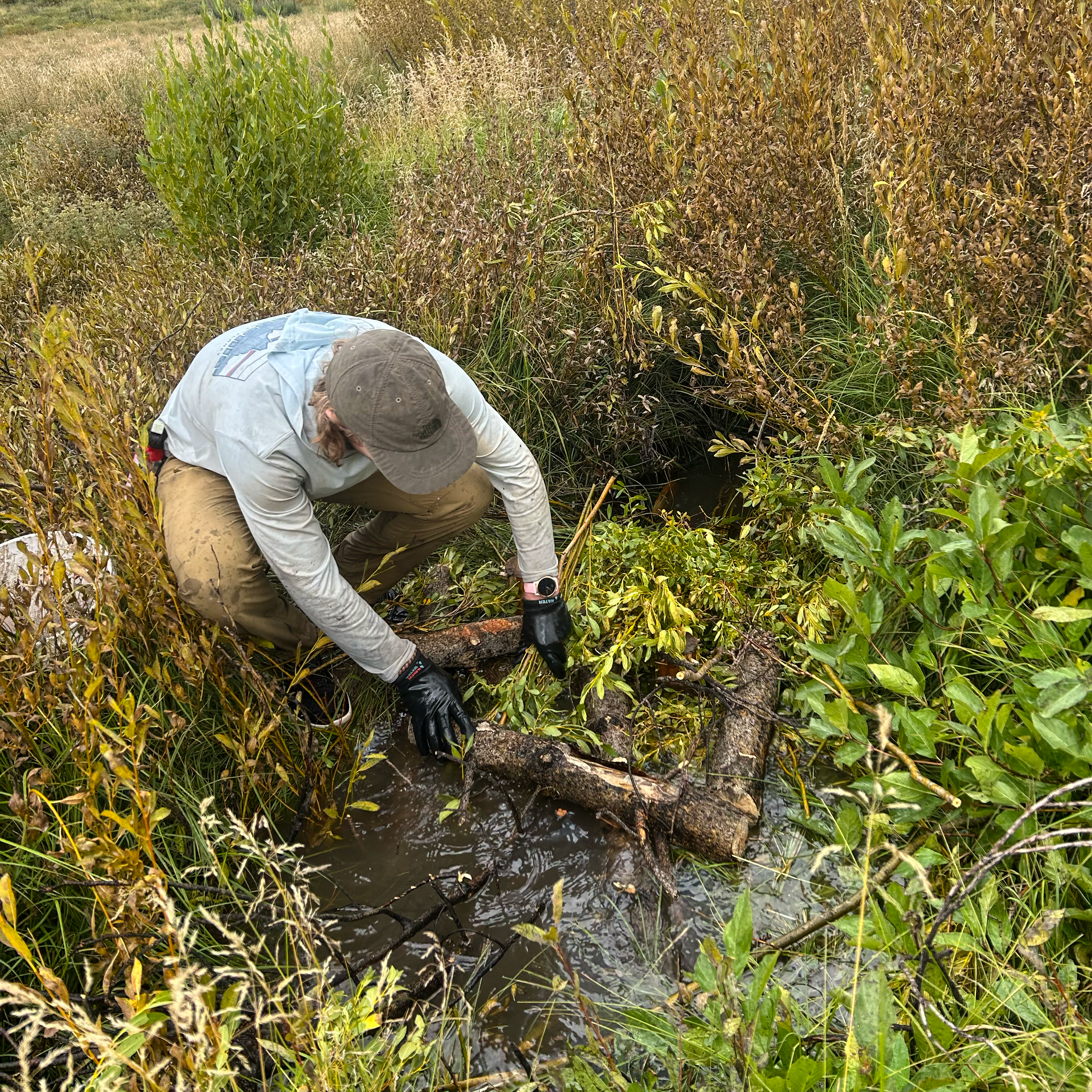
A volunteer constructs a BDA. Photo by Sage Lefkowitz.
What Is a Beaver Dam Analog?
A beaver dam analog is a human-made structure designed to mimic a natural beaver dam. Crews build BDAs across a stream channel, often in a series, using natural materials such as:
wooden posts
willow, spruce, and other on-site branches
sod and mud
small rock or gravel
Like a beaver dam, a BDA is porous. It backs up water behind it while still letting water continue downstream.
Restoration practitioners call this approach low-tech, process-based restoration. Instead of relying on heavy machinery or concrete, BDAs work with the stream's natural processes, so over time the stream does much of the restoration itself. The approach has spread quickly. Trout Unlimited reports that it and partners such as the U.S. Forest Service, the Bureau of Land Management, and state agencies have built thousands of BDAs across the country.
Why Streams Need Help: The Problem of Incision
Many degraded streams share a problem called channel incision. Over time, fast-moving water cuts down into the land and carves a narrow, deep channel. The stream ends up flowing well below its old floodplain and can no longer spread across the valley floor to water meadows and streamside vegetation. Groundwater levels drop, and wet meadows dry out.
Incision can be severe, especially after wildfire. At Great Basin National Park in Nevada, the National Park Service reports that parts of fire-affected Strawberry Creek have cut as much as 12 feet below the surrounding land. By slowing water and reducing its cutting force, BDAs help reverse this process.
Why BDAs Matter
BDAs are small interventions with big benefits for streams, riparian areas, and the wildlife that depend on them.
They store water on the landscape. By slowing flows, BDAs let the land beside the stream soak up and hold water like a sponge. This recharges groundwater and keeps streams and meadows wetter later into the summer.
They keep water cold and clean. Stored groundwater helps keep streams cooler and cleaner during the hottest months, when fish need it most.
They rebuild streambeds. Slower water drops the sediment it carries. Over time, that sediment raises the channel back toward its floodplain.
They reconnect streams to their floodplains. As water levels rise, water can spill back across the valley floor during high flows. This supports wet meadows, willows, and wildlife habitat.
They create fish habitat. Pools and slow backwater areas behind BDAs give fish places to rest and overwinter. They also provide refuge in dry years. In Oregon's John Day River basin, research found that natural beaver dams and BDAs benefited a threatened steelhead population.
They improve riparian habitat for wildlife. Healthier streamside vegetation provides food, cover, and nesting habitat for moose, songbirds, amphibians, and many other species. Riparian areas cover a small fraction of the West's landscape but support a large share of its wildlife.
They can invite beavers back. Encouraging beavers to return is often a key goal of BDA projects. On Malheur National Forest's Camp Creek, a beaver family anchored a new dam to restoration wood placed in the stream. By 2016, several new beaver dams were speeding up the creek's recovery. As the National Park Service notes, beavers are ultimately the best stream restorers, because they maintain and improve their dams year-round.
BDAs and Wildfire
BDAs are especially valuable before and after wildfire. Wet, reconnected floodplains can act as natural firebreaks and give fish and wildlife refuge during fires.
After a fire, burned slopes lose the vegetation that holds soil in place. Rain and snowmelt then wash ash, sediment, and debris into streams. That material can bury habitat, smother the aquatic insects fish depend on, and lower dissolved oxygen levels (which can kill fish). BDAs and natural beaver dams help capture this material and sequester it before it moves further downstream.
Building a Better BDA: The "BDA 2.0" Design
BDA construction methods have evolved as practitioners learn what works best. Earlier structures, often called BDA 1.0 or "wicker weave" BDAs, started with a row of posts. Crews wove willow branches between the posts and added supporting material at the end.
The updated BDA 2.0 design is more robust and follows a different construction sequence. Key features include:
An upstream ramp and a downstream mattress. The ramp is a wedge of sod, branches, and other material on the upstream side. The mattress is a bed of willow and spruce or fir branches on the downstream side that absorbs the energy of water spilling over the structure. Crews build both at the same time.
Construction in "lifts." The structure rises in 6- to 12-inch layers. Each lift must be holding back water before the next one is added.
A wide base. BDA 2.0 structures are built with a base two to three times as long as they are tall. A 3-foot-tall structure measures roughly 6 to 9 feet long in the direction of streamflow, including the ramp and mattress.
The right mix of materials. Material that is too coarse lets water slip through. Mixing small rock and wood with finer material such as branches, willow, mud, and sod seals gaps and adds stability.
Flexible post installation. Posts can go in first and serve as a frame for layering material. Crews can also build a "postless" structure and drive the posts in afterward. For extra strength, posts can be set in two staggered, parallel rows in a slight convex curve across the channel. The upstream row stands vertical, and the downstream row angles slightly upstream.
A center notch. A notch in the middle of the finished structure directs water over the center and away from the stream banks, which helps prevent erosion.
Crews often build secondary structures downstream of a main BDA to protect its base. Built in a series, these structures can be "stepped up" to gradually raise water levels toward a target, such as the elevation of an old, disconnected floodplain.
Site selection matters too. Crews look for spots with the right stream conditions and a good supply of wood, brush, and mud nearby. Where conditions aren't right for a BDA, practitioners sometimes use post-assisted log structures (PALS) instead. PALS are looser piles of logs, stumps, and branches that mimic natural logjams, add wood to wood-starved streams, and help limit incision. Any BDA project also requires the appropriate permits from land management and regulatory agencies.
Volunteers in Action: Trail Creek and the Pack Trail Fire
On September 1 and 2, 2026, the JHWF partnered with the U.S. Forest Service for an overnight volunteer project on Trail Creek, a tributary of Fish Creek past Goosewing in the Gros Ventre drainage. The creek was affected by the Pack Trail Fire, and the goal was to build BDAs that help keep ash from flowing downstream, where it can harm fish habitat and water quality.
This was not a casual outing. JHWF rated the project an 8 out of 10 in difficulty. Volunteers carpooled from the Gros Ventre Roundabout early in the morning. Each day, they hiked about 2.5 miles each way to the work site, crossing a creek and climbing a short hill. At the site, they worked directly in the stream, pounding posts and hauling logs, branches, and mud. The crew camped overnight between workdays.
JHWF provided tools, training, some food, and camping logistics. Volunteers brought their own camping gear, layers, rain jackets, eye protection, sturdy shoes, and often waders.
The days were long and full of muddy, physical work in a remote creek, and every bit of it was worth it. Each structure the crew built will help slow the water, catch ash and sediment, and give a fire-scarred stream a better chance to recover.
The Trail Creek project followed a similar single-day effort on August 22 on Pine Grove Creek near Big Piney, where volunteers built structures closer to vehicle access.
Projects like these show the power of community-based conservation. With hand tools, willow branches, and many willing hands, volunteers can give fire-affected and degraded streams a head start on recovery. The benefits last for fish, wildlife, and downstream communities. Every structure built brings a stream one step closer to health. And it's a reminder that some of the best conservation ideas come from nature itself.
Read more about beaver dam analogs from the National Park Service, Trout Unlimited, Working with Beavers, and the U.S. Forest Service.