
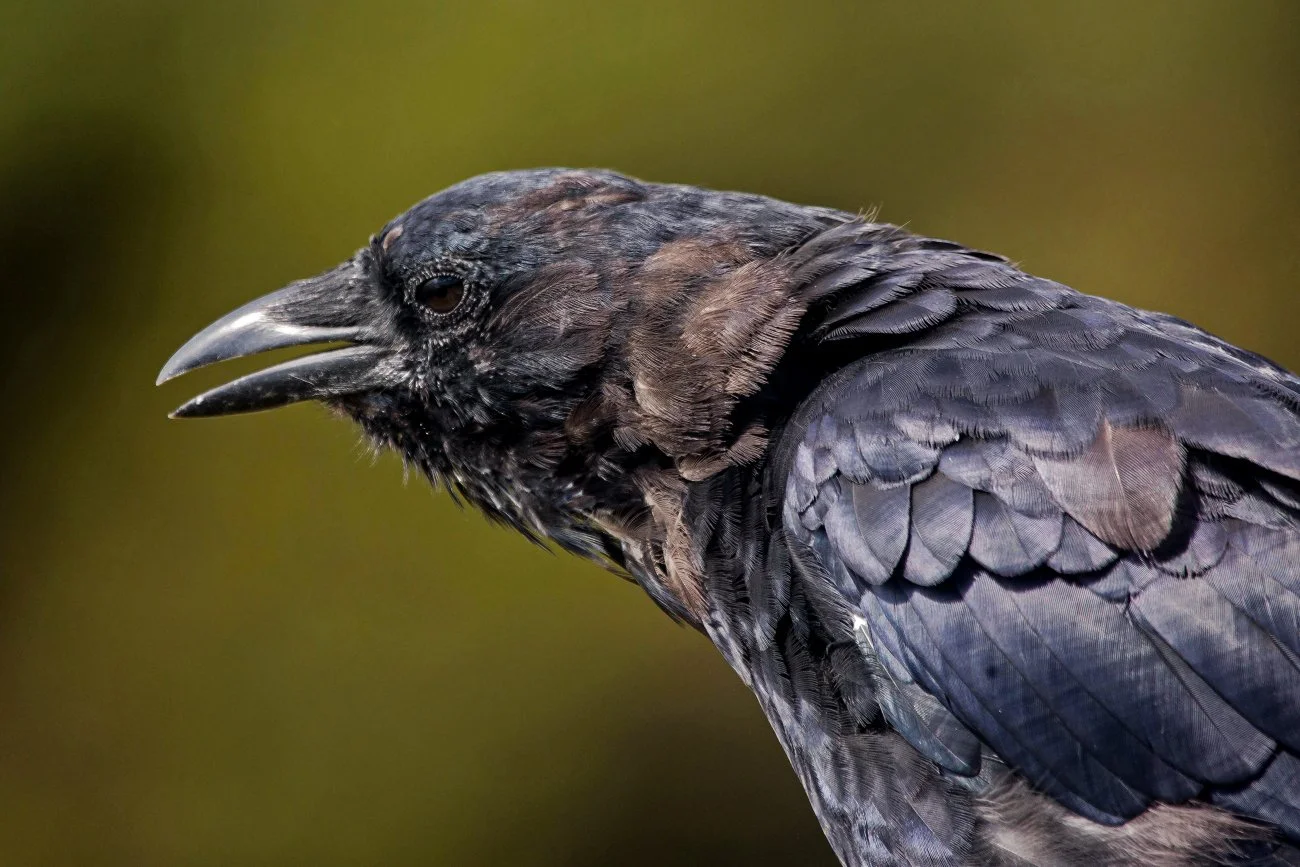
Corvus brachyrhynchos, the American crow
Wyoming Game and Fish Department has an official hunting season for crows: Nov. 1 to Feb. 28. Killing is by firearm, archery, or falconry. No license required, no bag limit. A departmental advisory informs hunters about distinguishing crows, which can be killed, from ravens, which are protected under the Migratory Bird Treaty Act. Ravens have wedge-shaped tails, are more skilled at soaring, have stouter beaks, are larger than crows, and vocalize differently. It is more a croak than a caw. If you ever camped in the forest under a group of ravens, you soon learn the difference. Ravens gossip a lot, especially about two-legged visitors.
Ravens are nominally protected under the Migratory Bird Treaty Act. Yet county predator boards and USDA’s Wildlife Services personnel routinely kill ravens. My local predator board targets ravens because it considers them a nuisance at one mining site near Laramie. I was surprised to hear that there were so many in Albany County that they were a problem. Most Wyoming ravens live in the western part of the state. I asked the board’s trapper if he was sure they were ravens and not crows. He was. But dollars to doughnuts, he is killing crows.
A recent article in Cowboy State Daily celebrated crow hunting. It featured an 85-year-old man from Riverton who killed crows from the age of 14. A picture shows him holding aloft fistfuls of crows. He wears camouflage, as befits the fearless hunter. He says in the piece, “All the ranchers will let you hunt crows. I have never been refused access to hunt crows. They all hate them.” Yet to his credit, he notes that crows are smart.
Intelligence is a feature of corvid species such as crows, magpies, jays, and ravens. Relative to body mass, corvid brains are comparable to those of great apes and dolphins. Their brains are organized differently compared to those of primates. Researchers consider them to be among the most intelligent of animals. Two anatomical features are probably involved. Neuron packing density is high in the front part of their brains, and associative neurons are organized in a distinctive, efficient way.
Published studies document the intelligence of crows. It has long intrigued and puzzled neurobiologists and behavioralists. Crows remember individual human faces, as was documented in a famous study at the University of Washington. Crows on campus could distinguish between "good" and "bad" human and then hold grudges against the bad ones. They taught fellow crows how to recognize specific individuals considered a threat to the flock. That knowledge was passed down through several generations of crows. They make and use tools, once thought to be an attribute of primates alone. Their problem-solving abilities are well documented in laboratory studies. They rival the skills of 5 to 7-year-old children. A short, entertaining, and accurate 5-minute cartoon on TED-Ed summarizes the skills of corvids.
I feed crows as well as other birds in my yard. It continues to surprise me how well crows interact with other visitors, particularly squirrels and Eurasian collared doves. There is no fighting. The species demonstrates diplomacy and (for the most part) good manners about who gets what and when. I put out feed, and the bonanza is spotted within minutes. Flock mates are alerted. I have three cats, who are allowed to roam the backyard. They present a proximate danger to birds. Yet I have never seen one kill a crow, or indeed stalk one. I assume the crows’ size, combined with flock solidarity and alertness to predators, are deterrents. The cats loaf on the verandah or in the lawn, watching the avian show without moving in for the kill.
I wonder when we might learn such wisdom.
