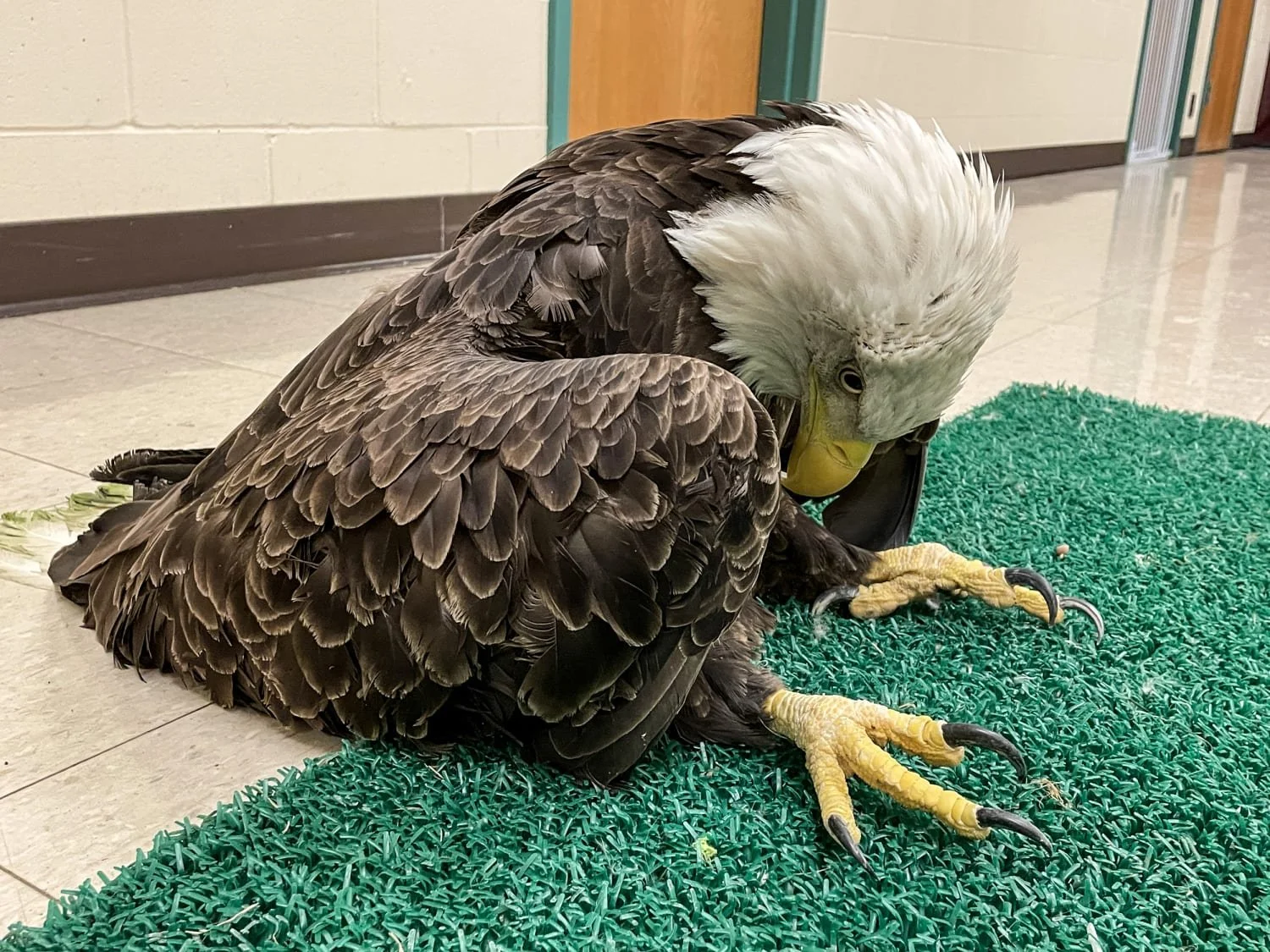
Lead-poisoned bald eagle (the Raptor Center, University of Minnesota)
Hundreds of peer-reviewed scientific articles exist on the impacts on wildlife of lead poisoning from lead-based bullets, lead shot, and fishing tackle. The insidious, long-term impacts of lead poisoning have been known for centuries. Lead in paint and children’s toys has been regulated in the U.S. for years. But lead ammunition and tackle remain largely unregulated. Lead poisoning was first identified as a disease in wild birds in 1842.¹
Overwhelming scientific evidence connects lead-based ammunition and tackle to ingestion by wildlife and subsequent poisoning. It affects avian and mammalian scavengers. It even affects people, who unknowingly consume lead fragments in harvested meat. A study by the Minnesota Department of Natural Resources revealed that all bullets will fragment on impact.
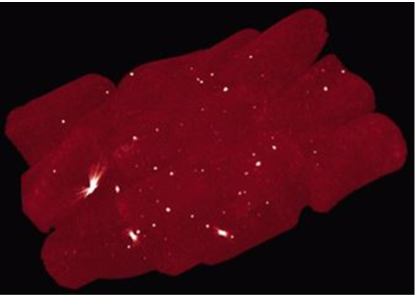
High-definition CT scan of a one-pound venison package. Bright spots are metal fragments embedded in the tissue.
Credit: Cornatzer, 2009
A 2007 University of North Dakota study found metal fragments in 59 of 100 venison packages donated to food banks (a serious concern for children and pregnant women eating hunter-harvested meat).²
The ecological toll is staggering. Hunters deposit an estimated 3,000 tons of lead annually in the U.S. Another 80,000 tons are released at shooting ranges and 4,000 tons are lost in ponds and streams as fishing lures and sinkers. The result: approximately 20 million birds and other animals die annually from lead poisoning in the United States.
Scavenging birds (eagles, hawks, vultures, condors) are especially vulnerable, ingesting lead from gut piles and unrecovered carcasses, resulting in problems such as depression, anemia, vomiting, diarrhea, ataxia, blindness, and seizures. Reduced cognitive abilities and an impaired nervous system can cause reduced food intake and impair coordination, all of which can kill. It also increases the risk of death from vehicle impact, predation, or starvation. It wasn’t until the early 2000s that fragmented bullets were recognized as a serious threat to scavenging wildlife, including birds that eat carrion.³
Lead played a significant role in the near-extinction of the California condor. A voluntary program with hunters was introduced to ease this problem. This resulted in 87 percent of hunters taking part – about 66 percent using non-lead ammo while approximately 11 percent removed the gut piles from the field. Unfortunately, if even one percent of remaining gut piles contain lead, condor populations remained at risk. If not for ongoing intervention and treatment by wildlife biologists who trap, test, and use life-saving chelation therapy to remove lead from the birds’ systems, the California condor would go extinct.³
A landmark 2022 study in Science found over 50% of 1,210 eagles nationwide had chronic to toxic lead levels, and one-third showed evidence of acute poisoning.⁵ Wyoming and Montana data tell the same story. When a Jackson Hole nonprofit educated hunters and supplied non-lead ammunition, blood lead levels in local ravens and eagles measurably declined.⁴
Donal O’Toole, a retired veterinary pathologist with the Wyoming State Veterinary Laboratory (and WYCAP board member), found that lead poisoning was sufficiently widespread to warrant routine testing of raptor carcasses, regardless of how they may have died. According to O’Toole, slightly less than half have chemical evidence of chronic lead poisoning. Estimates for acute lead poisoning in carcasses or ill birds are lower (27–33% for bald eagles; 7–35% for golden eagles).⁵ A survey of raptors in southwestern Montana generated similar results.
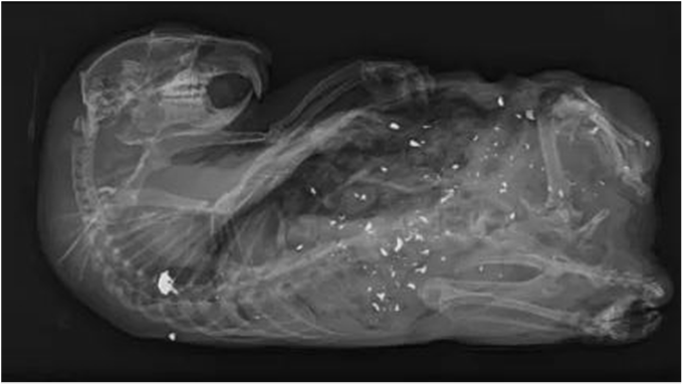
X-ray of prairie dog shot in Thunder Basin National Grasslands in 2017. The white specs represent lead fragments.
Credit: Teton Raptor Refuge
Another source of lead for scavenging raptors and mammals is from the loathsome practice of recreational shooting (“misting”) of prairie dogs and other small mammals. The radiograph below is of the carcass of a prairie dog collected after it was shot. The practice was reinstated by the USFS in the Thunder Basin National Grasslands in 2017. The rationale was to reduce competition for forage between livestock and prairie dogs. According to biologist Bryan Bedrosian with the Teton Raptor Center, in 2018 most of the prairie dog populations crashed due to plague, and so did the dependent nesting eagles. As if this wasn’t reason enough not to blast these important little dogs off the landscape, in a study of the consequences of misting, it was found that the amount of lead in a single prairie dog carcass shot with an expanding bullet was potentially sufficient to acutely poison scavengers or predators.⁶
In 2022, numerous groups again petitioned the US Fish and Wildlife Service about the issue. In response, the USFWS issued a new proposed ruling: “This rulemaking provides a measured approach in not adding to the use of lead on eight refuge lands.” The comment period evoked nearly 50,000 comments. The tentative timeline to phase out lead in these refuges is September 1, 2026. In addition, the USFWS launched a voluntary lead-free ammunition incentive program for the 2025-2026 season at 13 refuges.
Encouraging the use of non-lead ammunition, with the hope of changing attitudes and avoiding a formal ban, Sporting Lead-Free is a Wyoming-based initiative that educates people on the benefits of using non-lead ammunition and fishing tackle, providing resources on how to switch and where to find lead-free alternatives. Another group, huntingwithnonlead.org, is passionate about removing lead from the environment. The soft approach of education is more palatable for the hunting community. Yet if it proves that education alone does not reduce lead contamination in both our environment and wildlife, the alternative will be a formal state or national regulation.
However, going lead-free faces an uphill battle in Congress. In March 2026, the House passed the Protecting Access for Hunters and Anglers Act (H.R. 556), legislation that would prevent the Interior and Agriculture departments from restricting lead ammunition and fishing tackle on federal lands without site-specific scientific evidence to back the decision.
But folks, the goal is not to stop hunting—it's to make sure your bullet kills just once. You don’t want bits of slow-acting poison ending up in your kid’s elk burger.
Bibliography
Friend, M., Franson, J.C., and Anderson, W.L., 2009, Biological and societal dimensions of lead poisoning in birds in the USA. In Watson, R.T., Fuller, M., Pokras, M., and Hunt, W.G., (Eds.), Ingestion of Lead from Spent Ammunition: Implications for Wildlife and Humans. The Peregrine Fund, Boise, Idaho. DOI 10.4080/ilsa.2009.0104
Cornatzer, W.E., Fogarty, E.F., and Cornatzer, E.W., 2009, Qualitative and quantitative detection of lead bullet fragments in random venison packages donated to the Community Action Food Centers of North Dakota, 2007, in Watson, R.T., Fuller, M., Pokras, M., and Hunt, W.G., (Eds.), Ingestion of lead from spent ammunition: Implications for wildlife and humans, The Peregrine Fund, Boise, Idaho, USA. DOI 10.4080/ilsa.2009.0111.
Osborn, Sophie, draft manuscript, Feather trails--A journey of discovery among threatened birds.
Slabe, V.A., et.al., 2022, Demographic implications of lead poisoning for eagles across North America. Science, Feb. 2022, vol. 375, issues 6582: pp. 779–782.
Donal O’Toole, personal communication, Nov. 2022.
Pauli, J.N., and Buskirk, S.W., 2007, Recreational shooting of prairie dogs: A portal for lead entering wildlife food chains. Journal of Wildlife Management, pp. 103–108. DOI 10.2193.2005-620.