
Cyanide on the Landscape: the M-44 is Back
It’s not smart to leave cyanide lying about on public land. Cyanide is a potent toxin that, in small amounts (i.e., <1 g), causes lightheadedness, giddiness and rapid breathing, progressing to stupor, spasms, convulsions, and death. Symptoms of acute sodium cyanide poisoning develop rapidly. A published study conducted by personnel from the U.S. Fish and Wildlife Service in the 1980s used M-44 devices (see below) and penned dogs and coyotes to establish a timeline. Symptoms develop at 32 seconds of exposure. Animals are dead within two minutes.
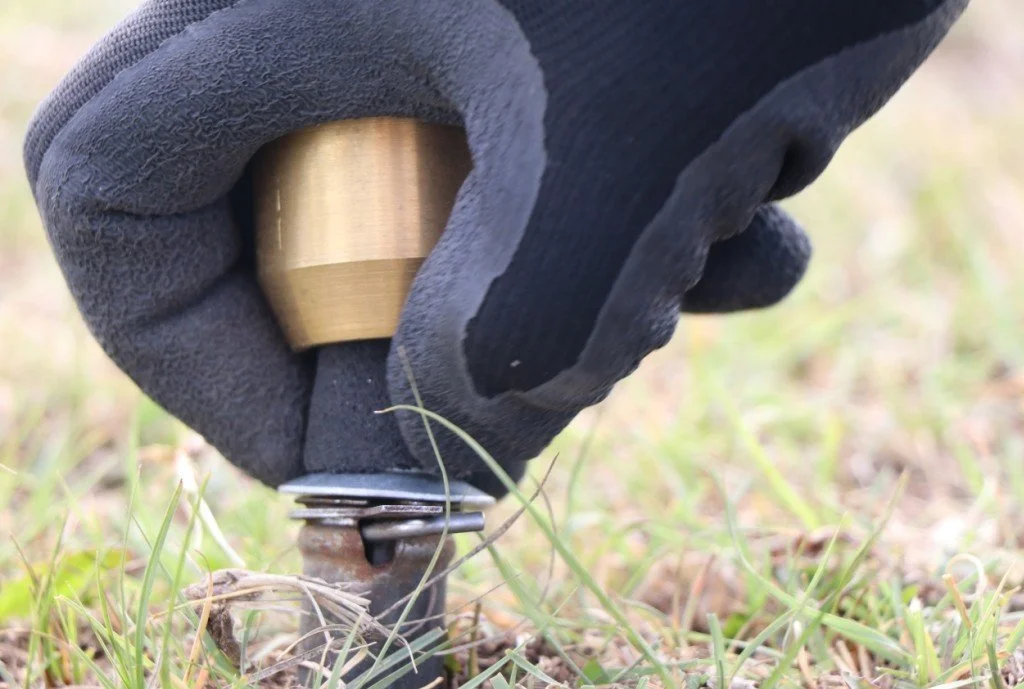
The exposed tip of an M-44. Source: Using the M-44 in Coyote Damage Control. Wyoming Department of Agriculture, 2020.
Wyoming now spends $4.8M a year in predator control. Much of it goes toward the killing of coyotes. There are no public figures for the number of coyotes killed annually in Wyoming, given the multiplicity of methods available. A rough estimate is 4,000 - 6,000, using state and federal dollars. Based on numbers from 2017, about 3.6% (164 of 4,503) of Wyoming coyotes killed in official programs are dispatched by M-44s.
Sodium cyanide is registered by the EPA as a restricted-use pesticide and a “predacide.” It is delivered to coyotes and other animals via a metal spring-loaded ejection device called an M-44. In addition to coyotes, targeted species include red and gray foxes, and stray dogs. All are considered a threat to commercial sheep flocks. The metal rod portion of the M-44 is inserted into the ground, leaving the cyanide-loaded tip exposed. It is smeared with scents attractive to canids. The protruding metal portion is sometimes confused with irrigation sprinklers or surveyors’ stakes, tempting some puzzled hikers to touch them.
The M-44 and its components are manufactured at the Pocatello Supply Depot in Pocatello, ID, a division of Wildlife Services. In addition to <1 g (0.03 oz) of sodium cyanide, each capsule contains one of several fluorescent marker powders. The latter are used so that WS personnel can determine whether an animal was killed as part of a WS program, or instead by commercial trappers with a state license to use the device.
The euphemistically named Wildlife Services (WS) is a division of USDA APHIS. WS promotes the use of M-44, and considers that the device is specific for coyotes. Once poisoned, scavengers eating a poisoned coyote will not be affected since cyanide gas generated from sodium cyanide does not persist in tissue. The metal device is robust and reusable over years. The cyanide in capsules is cheap to manufacture. One WS M-44 factsheet makes the claim that animals killed by sodium cyanide show no overt signs of distress or pain. While death can be swift, the combination of acute onset hypoxia, metabolic acidosis, and convulsions is not a barrel of laughs for either animal or owner.
As the design and use of the M-44 was modified over the years, the number of dogs killed, per WS records, declined. Between 1997 and 1999 the official annual tally of dead dogs was above 200. Since 2010, it has been between 17 and 40. The numbers are conservative and likely to be an undercount.
M-44s have killed Wyoming dogs. In March 2017, two dogs were exposed to cyanide while their humans hiked what they thought was Bureau of Land Management (BLM) land north of Casper. Both dogs died quickly and, according to the owners, in distress. At that time, the coordinator for predator management in the Wyoming Department of Agriculture estimated that “about” 300 M-44s were deployed annually on public and private land across the state. The department runs a training program in the use of M-44s so that users can be officially certified. One theme of the program is how dangerous sodium cyanide is to operators, and to ensure that such risks are minimized.
In response to public pressure, the EPA imposed 27 restrictions on how M-44s can be used. They can only be set on or within 7 miles of a ranch unit or allotment where predation on livestock by coyotes was documented recently. They cannot be set on federal lands formally set aside for recreational use. Warning signs must be posted on gates to pastures with implanted M-44s. Smaller stake signs must be placed in the pasture. Those are now the official requirements. After the two dogs were killed north of Casper, the owners looked for but could not find warning signs. Boundaries between BLM and private land in Western states are often unmarked or poorly flagged.
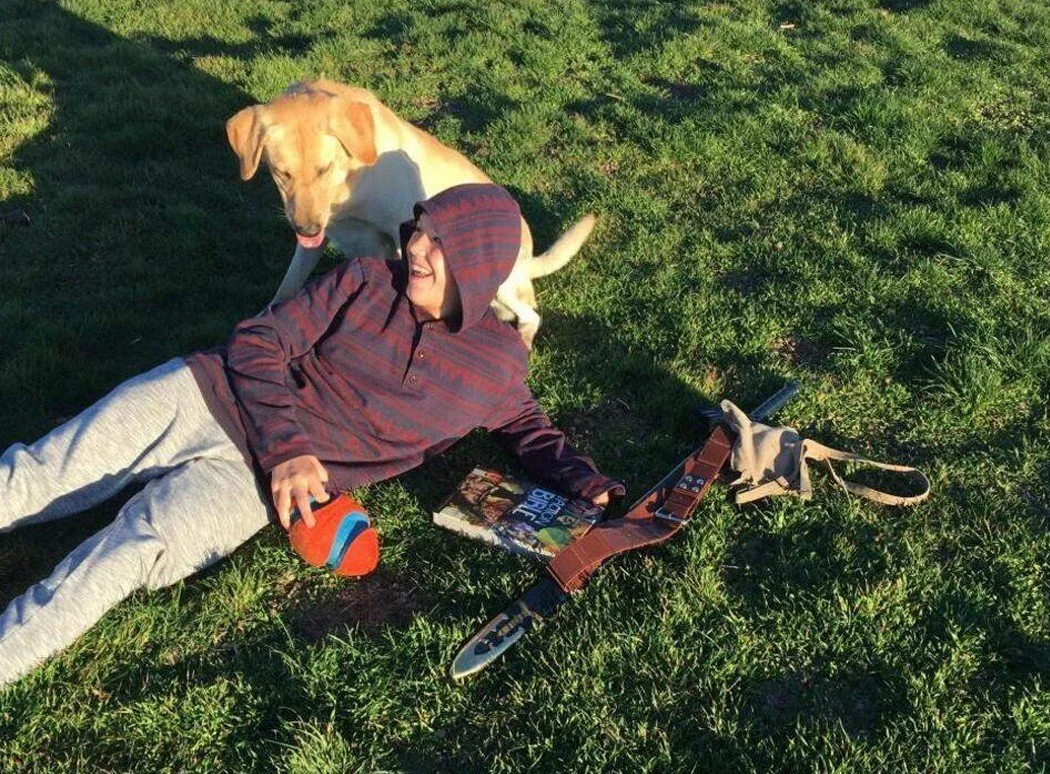
Canyon Mansfield with his dog, Kasey, before the March 2017 M-44 incident. Provided by Theresa Mansfield. Source: US-placed cyanide device ignites - and a Pocatello family is changed forever. Idaho Statesman, Sept 17 2018.
For decades, going back to the Nixon administration, use of M-44s on public land seesawed between being legal and being prohibited. The most recent cycle started in 2023, when the Biden administration banned the use of M-44s on all BLM-managed lands for five years. This was due largely to the publicity surrounding injury to a 14-year-old boy named Canyon Mansfield in Idaho, after he and his dog encountered an M-44 set close to his family home. The dog, Kasey, died. Canyon lived, but with medical sequelae, mostly migraine headaches.
It so happened that Canyon’s father was a physician who decided to push this as a safety issue. National awareness of M-44s increased as a result. The government’s response was that any negligence by WS employees was outweighed by Canyon’s. The Mansfield family received $38,500 compensation: $30K for the boy’s pain and suffering, and $8,500 for loss of the dog. The government did not offer an apology as part of the settlement.
M-44s are again poised for use on BLM land, thanks to the Trump administration. In May 2026, a memorandum of understanding was signed between the BLM and WS. It supersedes the Biden suspension policy from 2023. Written in opaque bureaucratese (there is no other kind) the MOU lifts the ban on M-44s. Interestingly, a spokeswoman for the Bureau of the Interior later claimed the memo “does not itself authorize or expand use of M-44s.”
But dollars to doughnuts, the table is set.
What is odd about all this is that there are safer ways to control coyotes. Some, like sheep guard dogs, do not require killing. There are options exist, and are familiar to Wyomingites: tax-subsidized WS shooters in fixed-wing airplanes and helicopters; private trappers with guns, snares, and leghold traps; yote-mashers like Cody Roberts; and regional coyote killing contests. At least one sportsmans’ group in the state offers a $25 bounty for each killed coyote.
There are two major problems with the use of M-44s.
They discharge a lethal, fast-acting toxin. If you or your dog is sprayed in the face with cyanide, the likely medical outcome is grim. Wildlife Services claims they never killed someone with an M-44. Yet close calls are not rare. According to an investigative report by the Sacramento Bee in 2014, over the previous 25 years at least 18 WS employees and several private citizens were injured by this device.
The other problem is their indiscriminate nature, and the limited ability of dogs and non-target wildlife to read posted signs. A well-researched petition submitted to WS in 2017 by 20 conservation and wildlife advocacy organizations estimated that M-44s killed more than 50,000 members of >150 non-target species between 2000 and 2017. This included several federally- and/or state-protected species. Wildlife killed “accidentally” included Mexican gray wolves, grizzly bears, kangaroo rats, eagles, falcons, California condors, red-tailed hawks, great horned owls, armadillos, pronghorns, porcupines, long-tailed weasels, javelinas, marmots, snapping turtles, turkey vultures, great blue herons, ruddy ducks, sandhill cranes, and ringtail cats.
While I recognize that the coyote killing industry is a handy subsidy for trappers, devices that spray cyanide powder on contact are inherently dangerous.
A draft federal bill called Canyon’s Law was introduced in 2025 by Sen. Jeff Merkely (D-OR) to prohibit the use of M-44s on public land. Wyoming senators Barrasso and Lummis opposed it. As ever, they based their opposition on inflated, rarely challenged numbers of livestock losses attributed to coyotes each year.
M-44s need to be eliminated from all public lands.
